The Human Factors and Ergonomics (HFE) Professional Affairs Board in Australia (PABA) has recently adopted the International Ergonomics Association (IEA) HFE Core Competencies as its benchmark. Consequently, the PABA Certification Committee has undertaken a review of the CPE/CHFEP application process to reflect this.
PABA has an agreed new certification system which recognises the need for early career mentoring to support, promote and encourage professional development, as well as certification of those with more experience.
This new certification system has three entry points being:
- STUDENT – sHFEP – applicant undergoing tertiary training; access to a mentor who is an experienced CHFEP.
- ASSOCIATE – aHFEP – post-graduation / early career development; access to mentoring (away from their employer) in chosen domain/s, to guide them through full application process in steps.
- CERTIFIED – CHFEP – full application; process support from “buddy” CHFEP.
While we are still refining the details for the Student and Associate entry application points, we have re-opened the certification process and welcome applications for the Certified level, CHFEP applications.
Over the next month while the website is being updated with application information and resources, CHFEP applicants are welcome to submit an Expression of Interest (EOI) of their intent to commence their certification application here: https://hfesa.wavecrm.com.au/application/01JZVHECGD0ZEZMEYVFBB23TW6
All applications will cost $300.
Once an application is received, applicants will receive an email with instructions on how to complete and submit their application, along with a link to a onedrive folder to submit their documents. They will also be assigned a current CHFEP (formerly CPE) ‘buddy’ to support them through the application process.
When their application is completed, applicants will then be required to notify the HFE PABA that their application is ready to be assessed via this link: https://hfesa.wavecrm.com.au/application/01KCJNQVPAY7GMJY5TZ9ZHA61C
Assessment of applications will commence from February 2026, in order of the notification of readiness for assessment.
It is anticipated that applications will take on average one month for assessment. Note: this may vary per applicant and outcome/recommendations.
If unsuccessful, applicants will be referred to a mentor. This is to support them through the process of providing evidence of adequate knowledge in areas or domains where they are currently not competent, prior to their application being resubmitted and reassessed.
Certified Human Factors and Ergonomics Professionals (CHFEPs) have been certified by the Certification Committee of the Human Factors and Ergonomics Professional Affairs Board Australia (HFE PABA) and have demonstrated that they have the skills and experience to provide high quality and consistent advice and support in the area of HFE.
CHFEP is the highest level of HFE status awarded in Australia.
All CHFEPs are invited to attend regular on-line forums to discuss issues related to their practice as CHFEPs and seek answers to questions from the HFE PABA members. These forums are announced several weeks beforehand so please take advantage of these opportunities to stay informed.
DOMAINS OF SPECIALISATION
Derived from the Greek words ‘ergon’ (work) and ‘nomos’ (laws) to denote the science of work, HFE is a systems-oriented discipline which now extends across all aspects of human activity. Practising HFE professionals must have a broad understanding of the full scope of the discipline. That is, HFE promotes a holistic approach in which considerations of physical, cognitive, social, organisational, environmental and other relevant factors are taken into account. HFE professionals often work in many sectors or application domains. Application domains are not mutually exclusive and they evolve constantly; new ones are created and old ones take on new perspectives.
There are domains of specialisation within the discipline, which represent deeper competencies in specific human attributes or characteristics of human interaction.
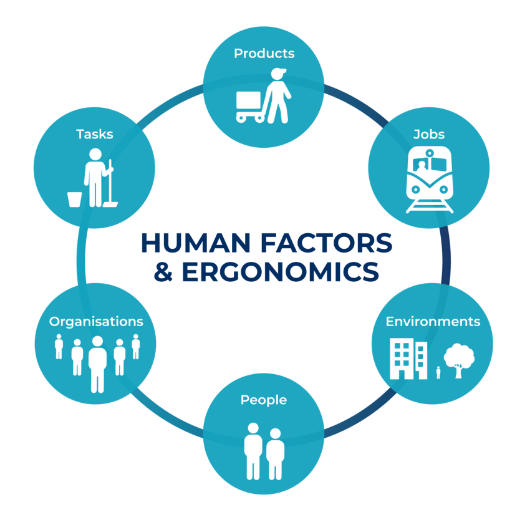
Domains of specialisation within the HFE discipline are broadly the following:

Physical Ergonomics
Physical ergonomics (HFE) is concerned with human anatomical, anthropometric, physiological and biomechanical characteristics that relate to physical activity. Relevant topics include working postures, materials handling, repetitive movements, work-related musculoskeletal disorders, workplace layout, safety and health.

Cognitive Ergonomics
Cognitive ergonomics (HFE) is concerned with mental processes, such as perception, memory, reasoning, and motor response that affect interactions among humans and other elements of a system. Relevant topics include mental workload, decision-making, skilled performance, human-computer interaction, human reliability, work stress and training.

Organisational Ergonomics
Organizational ergonomics is concerned with the optimization of sociotechnical systems, including their organizational structures, policies, and processes. (Relevant topics include communication, crew resource management, work design, design of working times, teamwork, participatory design, community ergonomics, cooperative work, new work paradigms, virtual organizations, telework, and quality management.) Organisational Ergonomics.
Source: International Ergonomics Society (IEA)
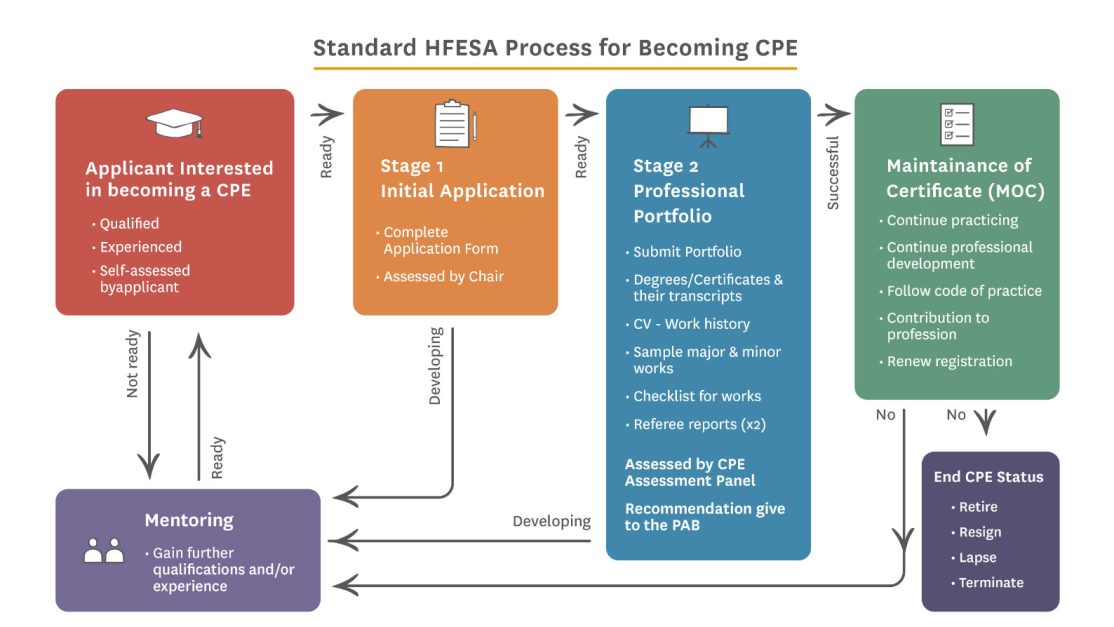
To become a CPE, the applicant must have:
- Completed a tertiary education program that includes a comprehensive set of the required IEA’s HFE competencies.
- Expertise in HFE demonstrated through the provision of at least one major work sample, supported by one or more work samples or products of smaller magnitude.
- A minimum of four years of full-time practice in HFE or the part-time equivalent.
The applicant needs to provide suitable references for the Professional Affairs Board to validate the application.
CPE PROCESS
The CPE Process flowchart describes the steps required to become a Certified Professional Ergonomist.